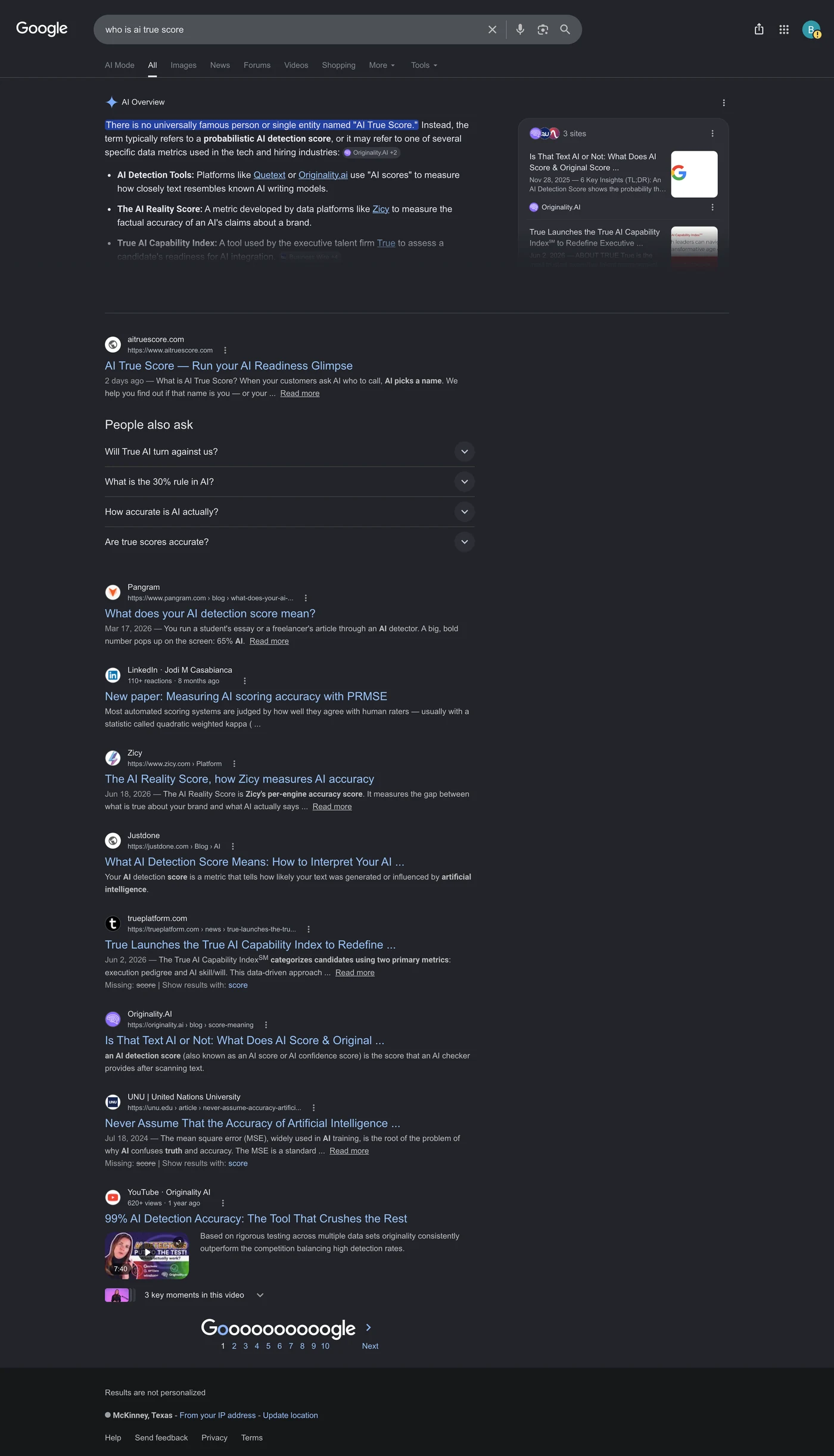
Two days after we launched AI True Score, we searched Google for “who is AI True Score.”
Good news first: our site was the #1 organic result. Indexing was fast, the rebrand redirects worked, the technical foundation held. Fine.
Then we asked the AI engines themselves who we are, the answer most people now stop at. And here’s the interesting part: they didn’t agree.
What did the AI engines say about us?
One knew exactly who we were; another described other companies.
Perplexity got us right. Asked the same question, it identified us as a business rather than a person, named our actual products — the AI Visibility Snapshot and the AI True Score Report, as they were called then (now the AI True Score Glimpse and the AI True Score Full Report) — described who we build them for, and cited our own pages as the source. It even offered to sort us out from any similarly-named person or app, unprompted.
Google’s AI Overview described other companies entirely. On July 16 it told us “AI True Score” was either an AI-powered resume and job-matching platform or a live sports scores app — two different businesses, neither of them us. By the next morning it had changed its mind again: there is no single entity by that name, it said, the term probably refers to the AI-detection scores sold by other vendors. Our site sat directly below that answer, in the #1 organic spot, uncited.
Same business. Same day. One engine knows us; another describes strangers. We build tools that measure exactly this split, and on day two we were a case study in our own product. If you’ve ever wondered why your business isn’t showing up in AI answers when it ranks fine on Google, this is one of the reasons.
Why can Google rank you while AI doesn’t know you?
Because ranking is mechanical and being known is not. That’s what the screenshot teaches, and it’s one of the most useful things an owner can learn about AI search right now.
Google ranked us because ranking is mechanical. We were a two-day-old brand name and Google had us at #1 almost immediately. That doesn’t happen by luck, and it isn’t magic either — it happens because the structure underneath was right: clean page structure AI and Google can read, one canonical address for every page, correctly executed redirects from our former name (so years of history carried over instead of evaporating), a sitemap that tells crawlers exactly what exists, and the same name used the same way on every page. Without that structure, this screenshot doesn’t exist — a renamed two-day-old site would have been invisible for weeks.
That’s the lesson of the first half: the mechanical layer works, and it’s the layer your website structure controls. It’s also exactly what the foundation checks in our reports measure. But ranking for your own name is where structure’s job ends — because then we read the AI Overview.
The AI answer didn’t include us because being known is not mechanical. An AI assembling an answer about “AI True Score” looked for corroboration — outside places that confirm the entity exists: who founded it, what it does, what it is NOT. We were two days old. The other companies with similar names had years of app-store listings and third-party pages. The AI did the reasonable thing with the evidence it had. We simply hadn’t given it enough evidence yet.
That’s the gap: your website can be winning at search while some AI engines still don’t know you exist — and different engines can hold completely different beliefs about you at the same time. Perplexity reads the open web fresh and found our pages; Google’s AI Overview leans on established entity records we were too new to have. Neither is broken — they just learn about you differently, at different speeds.
If that’s true for a company whose entire job is AI visibility, it’s absolutely true for a roofing company, a mortgage broker, or a med spa — where one engine recommends you, another names your competitor, and nobody sends you a memo about either.
What are we doing about it?
The same things our own reports tell owners to do, in public, so you can watch whether it works.
Say plainly what we are, and what we are not
Our About page now says plainly what AI True Score is and, because that’s who AI kept confusing us with, that despite the name we are not a resume, career or interview service. If AI confuses you with someone, clear it up on your own site first.
The fix: Ask one AI engine "who is [your business name] in [your city]?" If it describes someone else, add one plain sentence to your About page saying what you are, where, and who you are not.
Give the machines the boring facts
Founder, founding date, legal entity, former name: stated in structured data (the machine-readable layer of the site). Every fact real; nothing invented.
The fix: Write down your legal name, founding year, owner's name and any former business name. Ask your web person to add them to your site's Organization or LocalBusiness schema, exactly as they appear on your business registration.
Build outside corroboration
Company profiles on real platforms, linked back and forth with the site, so the business exists somewhere other than its own homepage. This is the slow part, and the part that moves AI answers.
The fix: Search your business name and list the profiles that come up. Claim the ones that are yours, make their facts match your site, and link each one to your homepage.
Tell the AI it’s wrong, politely, through the front door
Google’s feedback tools exist. We used them with accurate corrections, not marketing copy.
The fix: When a Google AI Overview gets your business wrong, use its feedback button and state the correct fact in one plain sentence. Never paste in sales copy.
None of this pays off the same day. Entity recognition moves in weeks and months, not hours; anyone who promises to flip an AI answer this week is guessing. We said that about AI answers on day one, and it applies to us too.
Why are we publishing this?
Because “we measure whether AI names you” lands differently when we show you our own scorecard, including the ugly part. At launch, ours reads: Perplexity knows us, Google’s AI Overview doesn’t yet. One for two — measured, not guessed.
We’ll update this post as the answer changes. If the playbook works, you’ll see it work. If it’s slower than we’d like, you’ll see that too — that’s the deal.
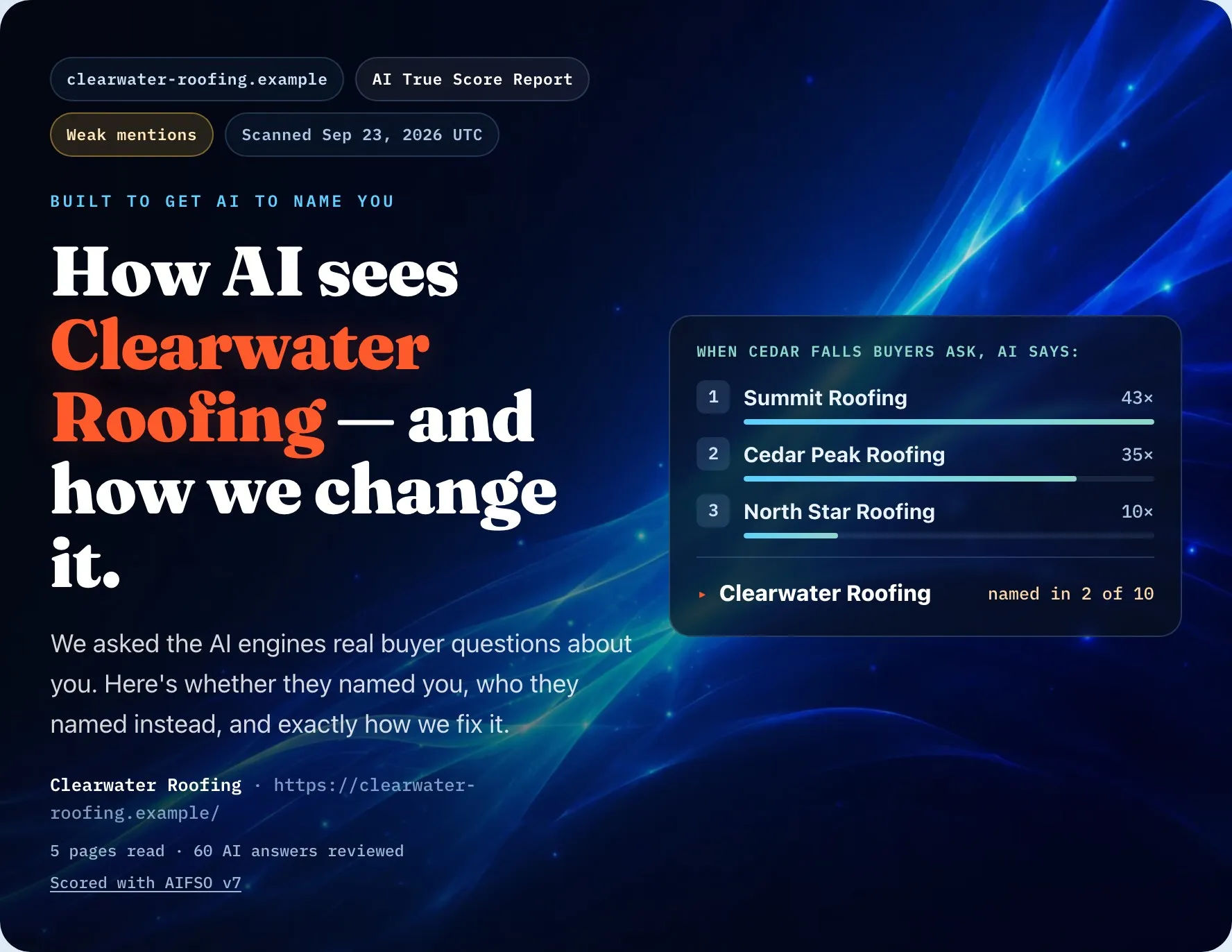
Meanwhile, if you’ve never checked what AI says when someone asks about your business, run the free AI True Score Glimpse: it asks AI real buyer questions and shows whether it names you, who it names instead, and your first fix.
Keep reading: Why isn’t my business showing up in AI answers? · Is my website AI-ready?