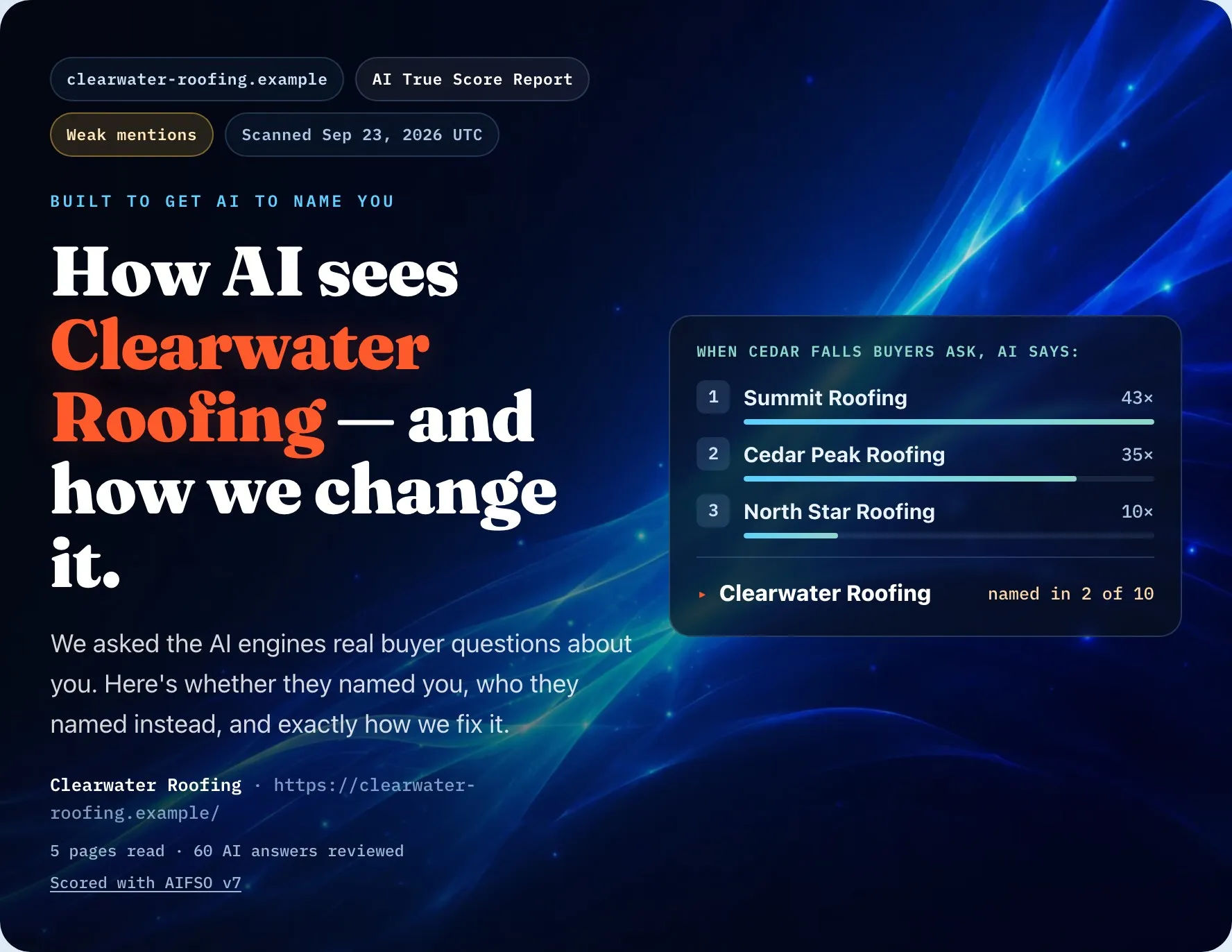
To check whether ChatGPT recommends your business, ask it the question a real buyer would, “who’s the best [your trade] in [your city]?”, in a private window, ask a second AI engine the same thing, and note whether you’re named or a competitor is. That’s the free manual method, and it takes about ten minutes.
Your customers are already asking AI who to hire, and you have probably never seen what it tells them. This guide shows the manual method step by step, then the faster free scan.
How do I check by hand?
Ask AI the questions your buyers ask, in a private window, on more than one engine, and write down who gets named.
Step 1: Ask like a buyer, not like an owner
Don’t type your business name; a buyer never does. Ask the questions a real customer asks:
- “Who’s the best [your trade] in [your city]?”
- “How much does [your main service] cost in [your city]?”
- “I need [your service] fast. Who’s available in [your city]?”
- “Who’s a licensed and insured [your trade] in [your city]?”
Those cover the big buying moments: choosing, pricing, urgency and trust. Every trade has its own version; our industry pages list the questions buyers ask AI in each trade, from roofers to dentists.
The fix: Write your four questions down now, with your real trade and city filled in, so you ask the same ones every time.
Step 2: Use a private window
AI tools personalise. If you’ve chatted about your own business before, the AI may answer in a way no real buyer would see. A private (incognito) or logged-out window shows you what a stranger sees.
The fix: Open a private window before you ask. If your answer mentions something only you have told the AI, start again logged out.
Step 3: Ask more than one engine
Each AI engine builds its answers differently, and buyers use more than one. Being named in one and missing from another is common, and it changes what you should fix.
The fix: Ask the same questions in ChatGPT and in one other AI engine your customers might use, and keep the answers side by side.
Step 4: Write down who got named
The names in the answer are your real competition for that question: not the shop across town you’ve always watched, but the businesses the AI trusts enough to recommend.
The fix: Make a simple table: question, engine, who was named, and whether you were. That table is your baseline.
Step 5: Repeat it monthly
AI answers move as the engines re-read the web and your competitors publish. One check is a snapshot; a monthly check is a trend.
The fix: Put a monthly reminder in your calendar: same questions, same engines, ten minutes. Add a new column to your table each time.
What can’t the manual method tell you?
It shows you what AI says, but not why, and it’s easy to misread. It has three blind spots:
- One answer proves little. Answers vary from run to run, so you need a spread of questions to see the pattern.
- It tells you what, not why. If you’re not named, asking by hand can’t tell you whether AI can’t read your site, can’t confirm your facts, or can’t find proof it trusts. Our guide to why a business isn’t showing up in AI answers covers the usual reasons.
- It’s easy to fool yourself. Owners naturally ask the questions they’d win and stop when they see their name once. Buyers aren’t that kind.
Is there a faster way?
Yes. The free AI True Score Glimpse asks AI real buyer questions for you and shows whether it names you, who it names instead, and your first fix. No account, no card, about a minute.
For the full picture, the AI True Score Full Report asks the questions your buyers ask, on every engine in our report, and shows who each one names. It also runs the checks in our report on your site and puts the fixes in order, so you know why as well as what. Every report includes one free follow-up check, with an email saying what changed, so you can fix things and see what moved.
What should I do with what I find?
It depends on how often you were named.
- You’re named consistently: protect it. Keep your facts consistent and your proof visible, and keep checking monthly, because competitors are working on this too. Our playbook for getting recommended by ChatGPT covers the habits that keep you there.
- You’re named sometimes: you’re on the radar but not trusted enough to be the default. Small clarity fixes usually move this the most.
- You’re not named at all: that’s common, and usually fixable; the gap is almost always in what AI can read and confirm about you, not in your work.
The fix: Look at the business named most often in your table and read its homepage's first two sentences. If they say trade, towns and proof more plainly than yours, rewrite yours to match that clarity.
Should I buy a tool or hire help?
Only once you know what you’re paying to fix. If your check sends you looking for help, compare before you spend: our comparison of AI visibility tools lists prices and sources, and we compare AI True Score head-to-head with Otterly, the Semrush AI Toolkit, HubSpot’s AEO Grader and hiring an agency.
The bottom line
Nobody can guarantee that an AI will recommend you, and you should walk away from anyone who promises it. What you can do is measure where you stand and remove every reason AI has to name someone else. Checking is the first step, and now you know two ways to do it.
Run the free AI True Score Glimpse to see what AI tells your buyers today.
Keep reading: Why isn’t my business showing up in AI answers? · Get recommended by ChatGPT