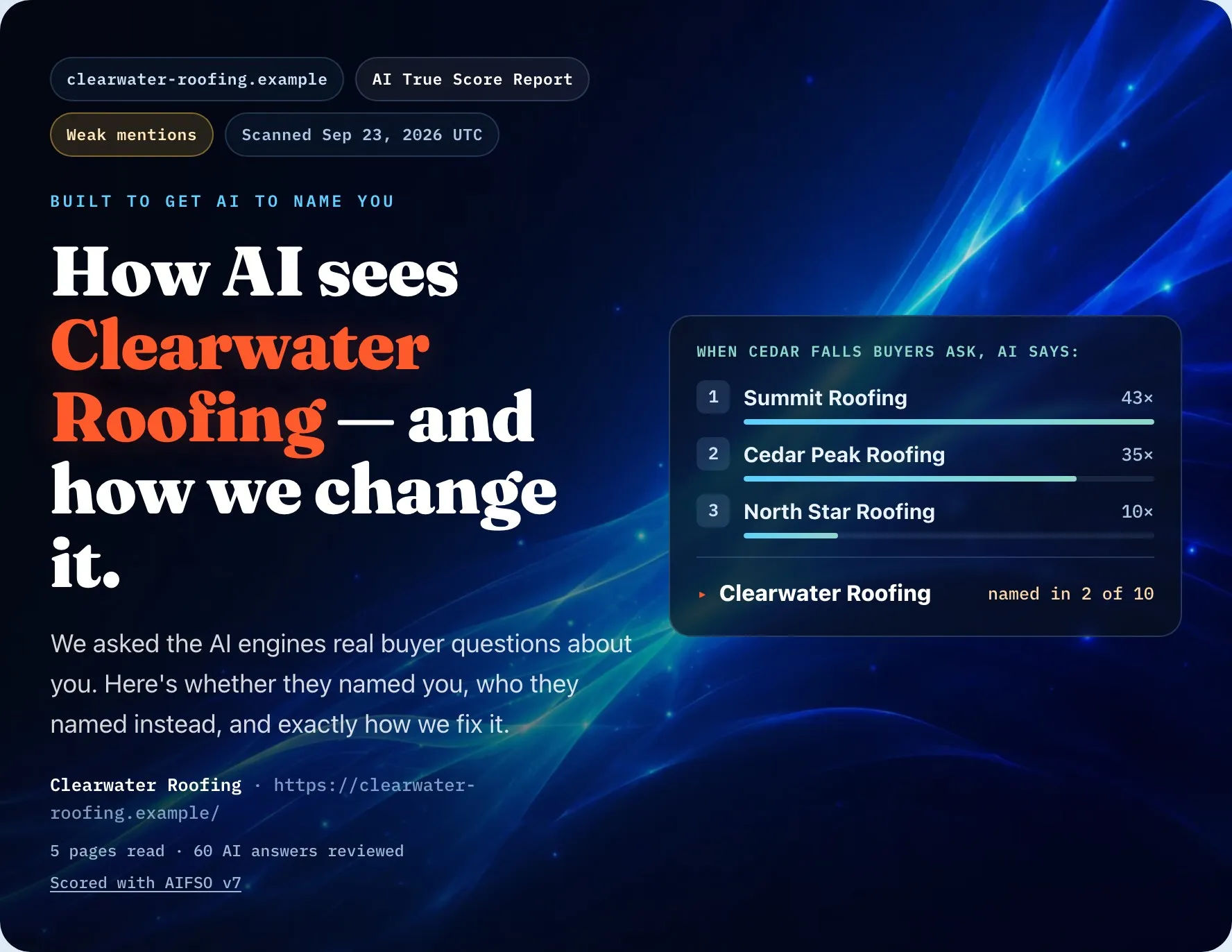
AI share of voice is the percentage of AI-generated answers that mention your brand across a set of test prompts: a number borrowed from advertising and PR, now pointed at ChatGPT and other AI assistants.
It sounds precise, and several tools put it front and centre. But for a local business it can point you at the wrong scoreboard.
What is AI share of voice?
It’s your slice of the mentions when a tool asks AI a set of test questions. Picture a tool that runs its questions through AI engines, counts how often each business is mentioned, and reports the results as slices of a pie. If your name shows up in 6 of 30 answers, you’ve got a “20% share of voice”; a competitor mentioned 9 times has 30%.
It’s a real concept, and it’s a headline metric for several AI visibility tools, including Otterly and the Semrush AI Toolkit. It’s one of the ways to measure the field our guide to what AEO is describes.
Why do tools lead with it?
Because one percentage is easy to sell and easy to chart: a number that moves, a competitor to beat, a tidy graph. For a large brand tracking many products across a category, that trend line has real value. The problem is that a metric built for national brand tracking gets handed to a local business as if it were the finish line.
Why can it mislead a local business?
The percentage can look fine while your phone stays quiet, for four reasons.
- It measures a basket, not a buyer. Your share can climb on broad, informational questions while you’re still never named on “best [your service] in [your city],” the question that sends someone to your door.
- A mention isn’t a recommendation. Being listed in passing (“options include…”) counts the same as being the business the AI recommends.
- There’s no standard definition. Every tool picks its own prompts, engines and counting rules, so the figure is only comparable to itself.
- A percentage hides the yes or no. An answer engine usually gives a buyer one or two names. You’re in that answer or you’re not.
The fix: If a tool reports your share of voice, open its list of prompts. Count how many are questions a buyer asks right before hiring, such as "best [your trade] in [your city]." If few are, add those questions or track them yourself.
What should I measure instead?
Whether AI names you when a real buyer asks. That’s a yes-or-no answer on the specific questions your customers ask, and it’s the core of AI visibility: you’re in the answer, or a competitor is. Pair it with whether AI can read, understand and trust your site, the same foundation behind whether your business shows up in AI answers at all.
That’s why our report is built around whether AI names you on buyer questions, not a share-of-voice percentage. It asks the questions your buyers ask, on every engine in our report, and shows who each one names.
The fix: Write down the questions your buyers ask right before they call someone. Ask ChatGPT each one in a private window and mark yes or no: were you named? That list is the number to watch.
No tool, ours included, can guarantee AI will name you, so be wary of anyone selling a percentage as if it were a promise. To see what AI says about you today, run the free AI True Score Glimpse: it asks AI real buyer questions and shows whether it names you, who it names instead, and your first fix.
Keep reading: What is AEO? · What is AI visibility?