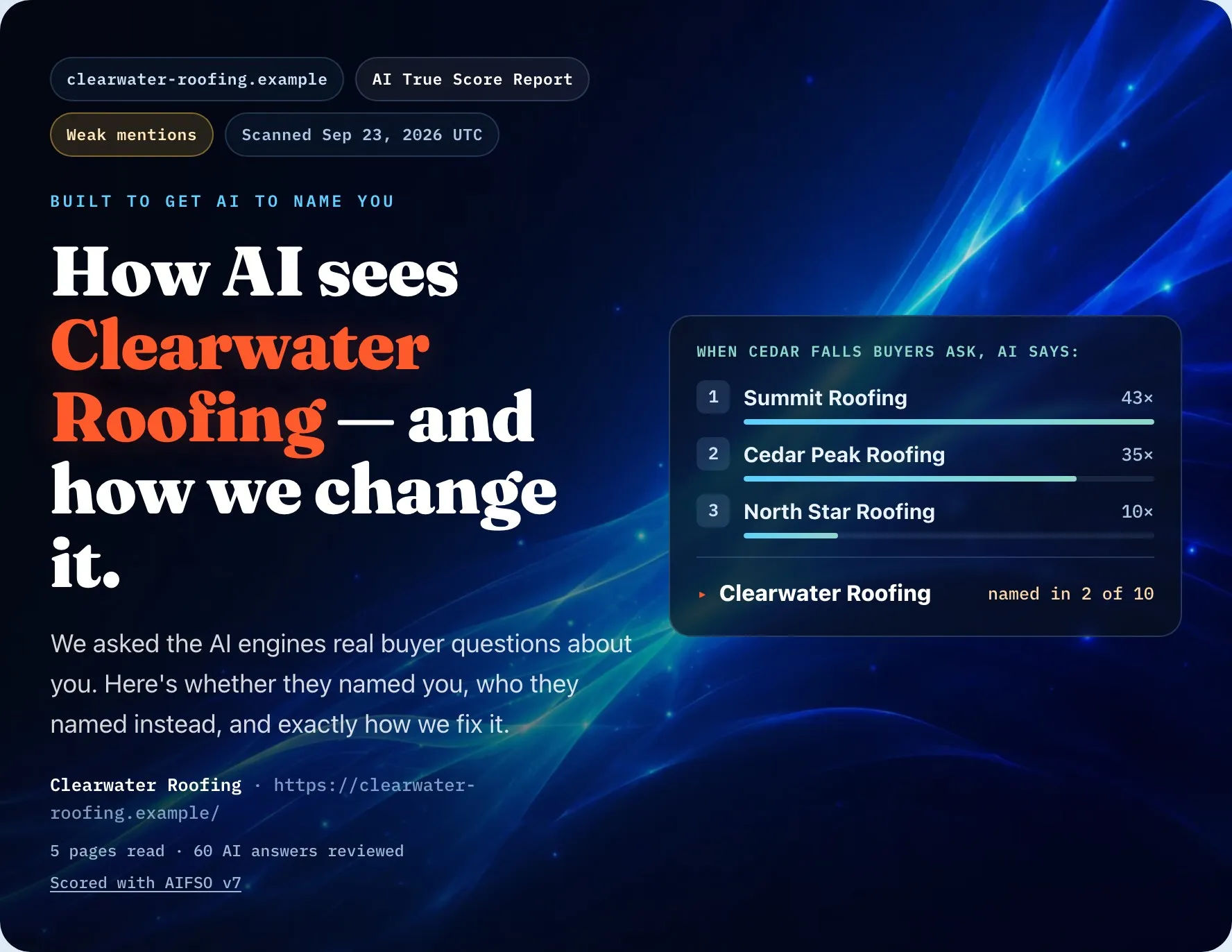
Answer engine optimization (AEO) is the work of making your business easy for AI tools to find, understand, trust and name when a buyer asks for a recommendation.
For years, getting found online meant one thing: ranking in search results so a person would scroll a list of links and click yours. That still exists. But more buyers now skip the list. They ask ChatGPT “who’s the best roofer in my area?”, read Google’s AI Overview instead of the links beneath it, or ask an assistant to “find me a licensed electrician open this weekend.” The tool gives back a short answer, sometimes one or two names. AEO is how you become one of those names.
What is answer engine optimization (AEO)?
AEO is the practice of making your business easy enough for AI answer engines to understand that they’re confident including you in the answer they give a buyer.
An answer engine is any AI tool that responds to a question with a written or spoken answer instead of a page of links. Most run on a large language model (LLM), the kind of AI that reads and writes text; ChatGPT is the best-known example, and Google’s AI Overviews put the same kind of answer at the top of Google. When someone asks one of these tools to help choose a local business, it doesn’t show ten options and let the person decide. It decides, then names a short list.
That changes the goal. When the buyer chose from a list, being on page one was a win. In an answer there often is no list, and more searches end without a click at all (that’s zero-click search). Being “findable” isn’t enough; you have to be the business the AI is confident enough to name.
How is AEO different from SEO?
SEO works to rank a page in a list of results; AEO works to get your business named inside a single answer.
They share a foundation. Both reward a site that loads fast, can be read by machines and says clearly what you do. If your pages are broken, slow or impossible for a machine to read, you’ll struggle at both. AEO builds on the SEO basics rather than replacing them. But the emphasis shifts in three ways:
- From keywords to questions. SEO often centres on the phrases people type. AEO centres on the questions buyers ask (“who’s reliable?”, “who’s licensed?”, “who can come out today?”) and whether your site answers them directly.
- From ranking to being named. SEO success is a position on a list. AEO success is your name in the answer.
- From pages to facts. Answer engines lean on clear, consistent facts about your business: name, services, service area, hours and proof. Scattered or contradictory facts give the AI a reason to leave you out.
You’ll also see the term GEO, generative engine optimization. It describes the same goal from a different angle, and the practical work is the same; here’s GEO in plain words.
Why does AEO matter for local service businesses?
Because the AI answer is becoming the first impression, and for local services the buyer is usually ready to call.
When someone asks an AI tool for “a good plumber near me,” they’re not researching for fun. They have a leak. If the AI names three companies and you’re not one of them, you didn’t lose a ranking; you were never considered. The buyer may never see your homepage, because they never had a reason to look for it. If that’s already happening to you, we cover the causes in why your business isn’t showing up in AI answers.
For a roofer, an HVAC company or an electrician serving a specific area, the bar is clarity, not budget: a site that plainly states who you are, what you do, where you work and why you can be trusted.
How do AI answer engines decide who to recommend?
They name the businesses they can read clearly and have reason to trust. In plain terms, an answer engine is asking a few quiet questions:
- Can I reach and read this site? If crawlers (the programs AI companies send to read pages) can’t reach your pages, or your key facts are inside images or scripts, you may not exist as far as the AI is concerned. More in AI crawlers, explained.
- Do I understand who this is and what they do? Your name, services and location should be stated plainly and the same way everywhere, on the page and in structured data (code that labels those facts for machines).
- Do they answer the question being asked? A site full of slogans but thin on direct answers (“Do you offer emergency service?” “What areas do you cover?”) gives the AI little to lift.
- Is there reason to trust them? Reviews, licenses, clear contact details and matching facts across the web tell the AI you’re a safe name to give.
- Can I place them? The AI needs to match you to this trade, this town, these services.
None of these are tricks. They’re what a careful buyer would want, made explicit enough that a machine can rely on them.
How do I measure AEO?
By checking whether AI names you when buyers ask, and who it names instead. That’s your AI visibility; how often you’re named compared with competitors is your AI share of voice.
AIFSO is the method we use to put AEO into practice and measure it. AIFSO is AI True Score’s proprietary framework for getting AI to name your business. It measures what AI engines say about you and your competitors, and it is retuned as the engines change.
The free AI True Score Glimpse asks AI real buyer questions and shows whether it names you, who it names instead, and your first fix. The AI True Score Full Report asks the questions your buyers ask, on every engine in our report, shows who each one names, and runs the checks in our report on your site. Our How It Works page walks through the process.
How do I start with AEO?
Find out what AI already understands about you, then fix the gaps in order.
Step 1: Get a baseline
You can’t fix what you haven’t seen. Ask AI what your buyers ask, or let a free scan ask for you.
The fix: In a private window, ask ChatGPT "Who's the best [your trade] in [your city]?" and write down who it names. That's your starting point.
Step 2: Fix the reading problems first
Readable pages and matching facts come before new content. There’s no point answering questions on a page the AI can’t read.
The fix: Highlight your phone number and services on your homepage. If you can't select them, they're inside a picture; retype them as real text.
Step 3: Answer the questions your buyers ask
Every trade has its own questions; our industry pages list them trade by trade.
The fix: Write down the questions customers ask you most on the phone. Add a plain answer to each one your site doesn't already cover, with the answer in the first sentence.
Step 4: Measure again
AEO isn’t one-and-done: engines change, and so should your evidence.
The fix: Put a reminder in your calendar a few weeks out to ask the same questions again, and compare who gets named.
The bottom line
AEO rewards clarity, not a giant budget or a technical background. The hard part is doing the plain, consistent work most sites skip. Once AI can understand and trust your business, being recommended stops being luck and becomes something you can work toward, though no one can guarantee it.
Ready to see where you stand? Get your free AI True Score Glimpse.
Keep reading: Why isn’t my business showing up in AI answers? · Get recommended by ChatGPT